|
Source: |
|
 |
|
Date: |
2005-03-18 | |
|
Researchers Find Three Major Beetle Groups Coming Up One
Testicle Short
BERKELEY – A surprisingly large number of beetles are
missing one of their testes, the male gonads of insects. As far as
the researchers who discovered this can tell, the insects are not in
any way bothered or impaired by this absence.
The discovery is striking because most animals are bilaterally
symmetrical, which means the left and right sides of the body
roughly mirror each other. This bilateralism extends to many
internal organs, although some systems, such as the human heart and
liver, develop or are positioned asymmetrically.
"We've got two lungs, two kidneys, and females and males have
paired gonads. Even our brain has two hemispheres," said Kipling
Will, assistant professor of insect biology at the University of
California, Berkeley's College of Natural Resources. "Evolution has
predominantly favored bilateral symmetry in animals, so when we see
that the rule is violated, as in the case with these beetles, it
gets our attention."
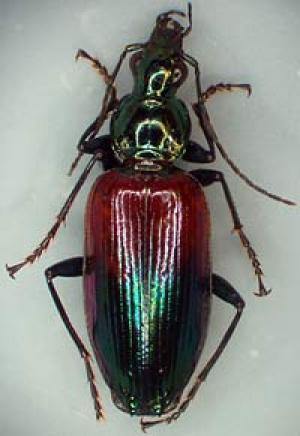
Will led a systematic survey of all major lineages of the beetle
family Carabidae. The results of the survey will appear in the April
print issue of the Journal of Morphology, but are available now
online.
The researchers said that field observations such as this provide
valuable clues to beetle biology and evolution.
The one-testis phenomenon, or monorchy, was first noted in
beetles by French naturalist Leon Dufour in 1825. He found that
Harpalini carabid beetles had a single testis, but he and other
scientists considered the condition to be limited to this group. It
would take another 180 years before researchers would conduct a more
thorough survey, finding that two other major lineages also lack one
testis.
The survey required detailed dissection and study of over 820
species, a representative sampling from the 37,000 species of
carabid beetles estimated to exist. The researchers found 174
species, all members of the three lineages with only one testis. The
researchers noted that except for this one anatomical distinction,
the one-testicle beetles appear and behave no differently than their
two-testicle counterparts.
"The beetles with one testis are mating normally and doing their
beetle thing," said James Liebherr, professor of entomology at
Cornell University. "It strikes me that carabid beetles are pretty
well known to scientists, yet the loss of an entire organ across
three major lineages was not fully comprehended until this
study."
For reasons unknown, in almost all cases it is the left testis
that has disappeared.
"You might say that these beetles lost all that was left, except
for one small group that seems to have lost their right," quipped
Will, who is also associate director of UC Berkeley's Essig Museum
of Entomology.
While animals such as jellyfish and starfish are radially
symmetrical, bilateral symmetry is, hands down, the dominant body
shape in the animal world, thanks in part to the drive for forward
motion.
That's not to say there is no precedent for such deviations from
bilateralism. One well-known example is the male fiddler crab, which
has an outsized claw on one side that is used to attract female
crabs and fend off male competitors.
Still, the researchers said the complete absence of an organ, or
absence asymmetry, is rare. When it does occur, there is likely a
good reason for the organ loss. Snakes, for example, have one lung
that is significantly reduced to accommodate a relatively extreme
body shape. Most birds have only one functioning ovary, which some
biologists believe helps optimize their bodies for flight.
That raises the question of how and why some beetles evolved to
have just one testis. The researchers ruled out obvious factors such
as flight advantages or major changes in body form.
They did notice that the monorchid beetles' accessory glands,
which produce the bulk of the seminal fluid, were somewhat larger
than normal. The researchers suggest that packing of the internal
organs in the abdomen is a kind of competition for space that may
lead to the loss of the functionally redundant testis.
"Male crickets will directly transfer fluid from their accessory
glands to female crickets to provide nutrition to their eggs," said
Liebherr. "It may be that the male beetles are similarly providing
other things than sperm to the females. But it's a chicken and egg
question. We don't know what came first. Was the testis lost first,
leaving more space for the accessory glands to grow? Or did the
testis lose out to make way for a larger accessory gland? That's a
subject for further study."
Whatever the ultimate cause, something drove the evolution of
this absence asymmetry.
"We found monorchy in three distantly related groups of carabid
beetles - Abacetini, Harpalini and Platynini - indicating that the
loss of the testis occurred at least three separate times in the
evolution of the beetles," said Will. "It seems unlikely that it was
completely random."
Based on the geographic distributions of the beetle groups
involved, Liebherr estimates that the origins of monorchy in the
beetles occurred 90 to 100 million years ago during the Cretaceous
period. "That era witnessed a dramatic increase in the diversity of
organisms," he said.
He added that these findings illustrate the value of basic
natural history.
"So many of the scientific discoveries today seem to occur
primarily on the molecular and genetic level, so findings such as
this are remarkable," said Liebherr. "A lot of the ideas that come
to the lab bench start in the field. We still have much to discover
by looking at whole organisms."
Other co-authors are David Maddison at the University of Arizona
and José Galián at the Departamento de Biología Animal Facultad de
Veterinaria in Murcia, Spain.
This research was funded by the National Science Foundation.
Editor's Note: The original news release can be found here.
This story has been adapted from a news release issued by
University Of California - Berkeley.
| 



.gif)
.gif)