Fight the bite with weaponry to battle mosquitoes
Expensive, high-tech gadgets not always best, experts say
By Jeordan Legon
CNN
Tuesday, July 1, 2003 Posted: 1838 GMT ( 2:38 AM HKT)
 |
Story Tools
SPECIAL REPORT
|

|
|
(CNN) -- Zap
them, swat them, spray them and curse them. Mosquitoes are here to
stay. But that won't stop fresh-air lovers from trying to get rid of
the pesky skeeters. From low-tech methods that cost practically nothing
to bulky gadgets that run hundreds of dollars, here are some methods
commonly used to try to keep bites to a minimum.
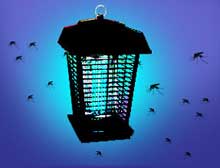
ZAPPERS
Most of these gadgets use the notion that bugs are attracted to
ultraviolet light. Once the bugs enter the contraptions, they hit an
electrified wire grid that essentially fries them. Consumers Union
tested these contraptions and found that they do indeed kill insects,
but not just mosquitoes. Wasps, flies, bees and moths all turn to
toast. Most make noise every time they fry a bug. This indiscriminate
zapping makes environmentalists cringe. You're going to kill insects
that might be beneficial to your garden, bug expert Rosmarie Kelly said.
CARBON DIOXIDE DEVICES
These devices generate carbon dioxide and warmth using propane. Some
also claim to mimic the scent of warm-blooded animals. But all that
fancy smell and heat production costs you money -- from a couple of
hundred dollars to close to $2,000, depending on the size of the area
you want protected. Consumers Union, which tested a few of these
devices, found after releasing a couple of thousand mosquitoes in a
15-by-30 foot room, two machines captured the most bugs: American
Biophysics' Mosquito Magnet Liberty and the Lentek Mosquito Trap. Bug
experts warn that these devices are not perfect. After all, they work
by attracting mosquitoes, so if you're anywhere around the device,
chances are, mosquitoes will be around you too, said Kelly, a medical
entomologist at the Georgia Division of Public Health. American
Biophysics Corporation suggests that their Mosquito Magnet traps be
placed 30 - 40 feet away from areas where people gather to prevent
possible bites.
DEET
Many mosquito repellents are made with the chemical
N,N-diethyl-meta-toluamide. It's a mouthful, but entomologists say
DEET, as it's commonly referred to, is a tried and tested way of
keeping bugs away. But to prevent possible health problems such as
dizziness, confusion or allergic reactions, bug expert Kelly suggests
adults should use DEET sprays or lotions with 30 percent concentrations
or less. Children older than 2 should use 10 percent solutions, she
said, and infants and women who are pregnant or nursing should stay
away from the stuff. Repellent industry experts also urge that DEET not
be applied around the eyes, mouth or nose. And users are encouraged to
try a patch test on a small area of skin before applying over more of
the body.
BATS
It might sound weird, but the idea of bats eating mosquitoes is
sometimes bantered about. Wayne J. Crans, a Rutgers University
entomologist, said bats are not the answer for controlling mosquitoes.
"Bats feed on the same insects that turn up in bug zappers and are no
more effective for controlling mosquitoes than their electronic
equivalent," he writes on the Rutgers Web site. "Providing habitat to
enhance bat populations is an admirable activity for conservation
purposes. Using mosquito control as the reason to initiate public
interest is misleading at best."
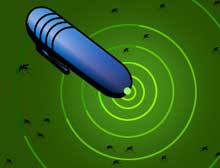
ULTRASONIC GADGETS
These small devices are worn on the wrist or clipped to a keychain.
Manufacturers say they make noises that repel mosquitos, and premium
models also claim to repel rats, spiders and hornets. But Crans, of
Rutgers University, advises buyers to stay away. "Scientific studies
have repeatedly shown that electronic mosquito repellers do not prevent
host-seeking mosquitoes from biting," he writes on Rutgers' Web site.
PESTICIDES
Experts say spraying pesticides in the bushes around your yard a day
before an outdoor gathering will help keep mosquitoes away temporarily.
More permanent solutions include spray systems like Mosquito Be Gone.
The sprinklerlike systems automatically spray several times daily. But
some experts worry that round-the-clock spraying might lead to
pesticide-resistant strains of bugs. Entomologist Kelly prefers a
product called Mosquito Dunks, a bacteria tablet that can be dropped in
standing water to target mosquito larvae. It is not toxic to other
insects, humans or animals, she said. "You can actually put it in
animal drinking water. It's very low toxicity."
CITRONELLA / NATURAL REPELLENTS
Citronella oil is known to be somewhat effective at repelling
mosquitos, but the problem, said Rutgers professor Crans, is that the
antimosquito claims made by distributors of plants genetically
engineered to emit a citronella aroma "have not stood up to scientific
testing." Crans writes that studies found: "crushing the leaf and
rubbing it into the skin did not keep mosquitoes from biting and mixing
the leaves into a slurry did not help." Pyrethrum, which produces
small, white, daisylike flowers, also is believed to act as a natural
insecticide. Numerous candles and sprays use lemongrass, sage, pine,
cedar, lavender and even soybeans to repel bugs. But if these products
work at all, they tend to have to be reapplied constantly to maintain
their effectiveness, Kelly said.
COMMON SENSE
Wear long sleeves and pants when going into areas with a lot of
mosquitoes. Remove standing water from your property. Sit near a fan or
someplace where there's a breeze. "Mosquitoes can't fly well when
there's even a light breeze," Kelly said. The U.S. Centers for Disease
Control and Prevention also recommends staying indoors at dawn and
dusk, which are peak biting times for some species of the bugs. And
replace your outdoor lights with yellow "bug" lights, which are
believed to attract fewer mosquitoes than white light, the
Environmental Protection Agency urges.