
Anthony Hopkins played Hannibal in Silence of
the Lambs |
A
caterpillar rarely found in Britain which found notoriety in the
thriller Silence of the Lambs, has metamorphosed into a nine
centimetre moth after being discovered in a potato field in north
Wales.
The death's head hawk moth usually thrives in warmer southern
climates and do not usually breed in the UK as the pupae do not
survive cold winters.
Its discovery hit the headlines last month after it was spotted
at the University of Wales' research centre outside Bangor.
The rarely-seen moth - the largest-ever found in the UK - has now
hatched at the university, after the brightly-coloured caterpillar
was discovered eating potato leaves in a bed of experimental plants.
The moth, which gets its name from the characteristic skull and
crossbones on its back, is more commonly found in southern Europe
and north Africa.
Dr David Shaw, director of research for the Sarvari Trust at the
centre in Abergwyngregyn, said the moth was not an attractive
insect.
"It is a fairly ugly looking creature, it is black in colour
underneath and it has a skull and crossbones motif on its back," he
said.

The moth is named because of its skull and
crossbones markings |
"We
gave it a name as a caterpillar, Larry, but now it is a moth that
has got to be changed to Loretta because it is a female."
The insect is best known for featuring in the Silence of the
Lambs, starring Oscar-winning Sir Anthony Hopkins as Hannibal
Lecter, when a serial killer left it in the throat of a victim.
Purple stripes
The caterpillars are bright yellow in colour with purple stripes
along their sides.
If provoked they will pull up their head and make a menacing
clicking noise with their jaws.
It is known to enter bee hives to feed on honey where it emits a
loud squeak like a queen bee.
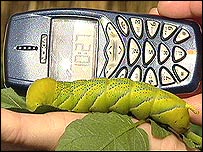
The giant caterpillar hatched into a 9cm moth
|
Last month a small number of the caterpillars were found in a
garden in Warwickshire.
The discovery took place in a garden in the village of Stockton.
Experts at a butterfly farm in Stratford-on-Avon said the
caterpillars' mother would have flown from north Africa to Britain
earlier this summer.
After her journey, she laid her eggs on a patch of potatoes in
the Warwickshire garden's vegetable plot.
The moth will be on display at an open day at centre in Bangor on
Wednesday as researchers show their new strains of blight-resistant
potatoes.










 E-mail this to a friend
  Printable version



.gif)

