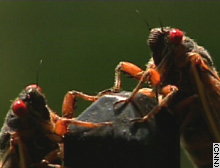
Cicadas leave bounty of nutrients for forests
Even in death, insects help ecosystem thrive
By Marsha Walton
CNN
Thursday, November 25, 2004 Posted: 1910 GMT (0310 HKT)
(CNN)
-- Every 17 years, billions of cicadas cause a loud stir in almost one
third of the United States. Scientists now say the insects also leave a
lasting and positive impact after they die.
"Even as dead
bugs they are still influencing these forest ecosystems," said Louie
Yang, whose research is published this week in the journal "Science."
Benefits
of the cicadas-as-fertilizer include faster growing trees, and bigger
seeds in some flowers for several years following the cicadas emergence.
Scientists
call short, dramatic bursts of new resources, like the billions of
cicada carcasses, "resource pulses." But unlike other pulses, such as
those that occur randomly after El Nino year rainfalls, researchers can
predict the appearance of cicadas almost to the day. That makes this
phenomenon a lot easier to study.
"I think these are pretty
charming and mellow insects," said Yang, a graduate student in ecology
at the University of California at Davis. "They don't move very
quickly, they don't sting or bite, and for the most part they are very
easy to handle and to touch to observe in nature," he said.
Cicadas
have a strange and fascinating life cycle. While flies and mosquitoes
live for just a few weeks, cicadas, depending on species, spend either
13 or 17 years below ground in the nymph stage, feeding on plant roots.
During
the few weeks they are above ground, there's a loud and frantic effort
for the insects to mate, and for the females to deposit their eggs in
trees.
"When you get thousands, or millions or billions of them together in one spot, it is a fantastic, deafening chorus," Yang said.
The
most noted cicada population, known as Brood X, emerged last spring and
summer in the eastern United States, from Georgia north to
Pennsylvania, west through the Ohio River Valley. When the eggs hatch,
the nymphs fall to the ground and burrow up to two feet below ground
for their very long growth period.
While they are above ground,
they become an unbelievably abundant food source for birds, lizards,
snakes and fish. The massive number of cicadas means that predators can
only eat about 15 percent of them.
As part of his research, Yang
and others gathered tens of thousands of insect carcasses to see what
impact they would have fertilizing bellflowers, a plant that's found in
roughly the same region as the cicadas.
"What we found was that
these plants are actually taking up nitrogen that comes from cicadas,"
said Yang. The seeds of the insect-fertilized plants were also 9
percent bigger than those in a control group.
Yang said
recruiting field volunteers to gather insect carcasses can be a
challenge. He's recruited family, friends, high school students, and
strangers, who responded to a newspaper ad. And he says they soon
become fans of the small creatures.
"These cicadas are
everywhere, so everyone knows them. All the people on the street know
your bug, and they often know the different species. The people I meet
know a lot about the insects, and they often ask me really challenging
questions about cicada biology," Yang said.
It's the safety in
numbers that has kept the cicada population thriving since the last Ice
Age. As individuals, Yang says they can be somewhat klutzy.
"They are not very agile fliers, and they don't seem to be very skilled at avoiding predators, " Yang said.
Especially
with such an intriguing insect, Yang says it is important to study
their entire life cycle, because they are fertilizing both below ground
food webs as well as above ground populations.
"When things die a lot of people stop paying attention to them," he said.