|
'Too late' to halt invasion by giant ladybirds
By David Derbyshire, Science
Correspondent
(Filed:
14/10/2004)
An invasion of Asian ladybirds that could
wipe out the native species has been going on for
months, researchers said yesterday.
The alarm was raised last month after a
single harlequin was discovered in an Essex pub garden.
Since the story appeared, readers have found scores of
the large, voracious harlequins in London, Folkestone,
Ipswich, Newmarket and Canterbury. Many were at least
two or three months old.
| |
 |
|
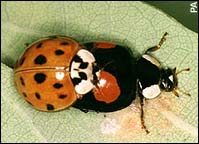
The Asian ladybird could threaten several
indigenous species |
Experts say it may already be too late to
repel the invaders.
Dr Michael Majerus, of Cambridge
University's genetics department, who launched the hunt
for harlequins, said: "My opinion last week was that if
we had caught the influx early enough, we might have
been able to eradicate it.
"Now I think there is no chance at all.
Instead, we have to look at damage limitation."
Harlequins are larger, hungrier and more adaptable than
other species.
They are most easily distinguished by
their large size: around 6-8mm long. Many also have a
distinctive W or M mark behind their heads.
They were introduced to North America
from Asia in the 1970s as an "environmentally friendly"
aphid control. Within two decades they had driven out
other ladybirds and aphid-eating insects.
Numbers have also risen in France,
Belgium and Holland.
Unlike the British species, harlequins
live in trees and on the ground. When aphid numbers fall
in summer, they turn their attention to hover-flies,
lacewings, butterfly eggs and even other ladybirds.
Dr Majerus believes 20 British ladybird
species, including the seven- and two-spot, could be
pushed to extinction.
He renewed his call for suspicious
ladybirds to be sent to: Dr Michael Majerus, Department
of Genetics, University of Cambridge, CB2 3EH.
|










.gif)
