|
Readers' guide to
fine art of killing a wasp
By David Derbyshire
(Filed: 18/01/2005)
Of all the inventions bequeathed to the
world by Sir George Sitwell, the eccentric father of the
poet Edith, perhaps the greatest was a tiny revolver for
shooting wasps.
Seated in the grounds of Renishaw Hall in
Derbyshire, the amateur landscape gardener would be
found taking pot shots at passing wasps with limited
success but enormous satisfaction.
More than 60 years after his death, the
spirit of Sir George lives on. According to a flurry of
correspondence from readers of The Telegraph, the fine
art of wasp shooting is alive and well. Which is more
than can be said for many of the wasps involved.
For the last two weeks, the letters page
has been buzzing with advice on the best way of
dispatching the pests.
In the cycle of good and bad summers for
wasps, 2004 was one of the worst in recent memory. A
combination of a mild winter and warm spring created
ideal breeding conditions and turned Britain into a
nation of picnic and barbecue flappers during the late
summer.
The tradition for shooting insects goes
back hundreds of years. Queen Christina of Sweden had a
pathological hatred of fleas in the 17th century and is
said to have kept a small cannon in her bedroom to fire
shots at the insects.
Paul Hargreaves, of West Grinstead, West
Sussex, suggested a modern day variant – using a
Berloque Pistole loaded with a 78 rpm gramophone needle.
"This unique miniature pistol makes short work of wasps
at distances of up to six feet," he said.
The disadvantage is that anyone
attempting to massacre wasps with the pistol could be
risking a jail sentence. According to the Worshipful
Company of Gunmakers, the weapon is classified as a
prohibited weapon under the Firearms Act. Owners could
face five years in jail.
A less risky attack can, according to
many readers, be made with air guns. Some believe a
blast of air at close range is enough, others say a
homemade salt pellet is needed to finish the job.
Among the gun enthusiasts, there is
division over whether shooting a trapped wasp is
sporting. While some recommend a target laced with
jam.
Alan Witherby, of Milford on Sea, Hants,
argued that conserve is against the rules of natural
justice. "Surely every self-respecting sportsman knows
one does not shoot a sitting wasp. In Hampshire we shoot
the driven wasp, high and fast flying. In a good summer
I have been known to bag as many as one."
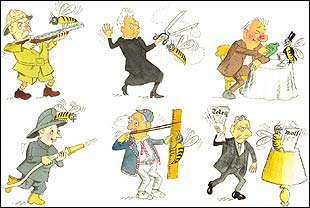
Another popular approach is the high
pressure hose. Many readers appear to combine the chore
of watering beds with the more exciting sport of wasp
dousing.
Other techniques highlighted by readers
include snipping wasps on a window pane with embroidery
scissors and a swift clout with a daily, ideally
broadsheet, newspaper.
Rita Greet of Liss, Hants, recalled
dipping a finger in an egg cup of gin and allowing a
wasp to settle on the finger. "Half a minute later it
took off in ever decreasing circles and flew into the
herbaceous border to sleep it off," she said. "It didn't
bother us again."
For those with sufficient grit, nothing
beats the thrill of extreme wasp fighting – a battle
without weapons to the death. "Shooting wasps is for
wimps," said Peter Sweetman of Madehurst, West Sussex.
"I've been safely killing the little blighters with my
bare hands for more than 40 years. A quick nip between
forefinger and thumbnail and off with their heads. Watch
their back end though - it can turn rather too quickly
for some people."
As for the well documented favourites - a
jam jar with water, or a well aimed boot - there was
little enthusiasm among readers.
Professional pest controllers say
one-on-one battles with wasps may be acceptable, but
amateurs should avoid taking on a nest. And while wasps
can be a nuisance in the late summer, in the spring and
early summer they are beneficial, eating greenfly and
other garden pests.
Richard Strand, of the British Pest
Control Association, said that in spring and early
summer wasps were usually only aggressive when they or
their nests were threatened by movement or a bright
torch.
However, their behaviour and diet changes
in July when they go in search of more sugary food. "It
seems they get more aggressive when they've been at the
rotting fruit," Mr Strand said.
He added that it was too early to predict
how many wasps this summer would bring, but it was sure
to provide plenty of opportunities for dedicated
hunters.
Cartoon ©Nicholas Garland
|