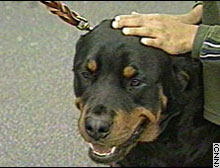
West Nile a threat to some animals
Household pets not at greatest risk, researchers say
By David Williams
CNN
Monday, June 6, 2005 Posted: 1528 GMT (2328 HKT)
(CNN)
-- An intricate microbial dance between mosquitoes and birds plays a
key role in the spread of the West Nile virus, as well as its
transmission to humans, pets and wildlife, experts say.
Infected
birds serve as reservoirs for the virus, which reproduces in their
bloodstreams. When certain types of mosquitoes bite the birds, they
become infected and can spread the virus.
Crows, ravens and blue
jays are the most susceptible to the virus and frequently die from it,
according to Alma Roy, the associate director of the Louisiana
Veterinary Medical Diagnostic Laboratory.
"Other birds don't
necessarily die, but they can still pass on the virus," Roy said.
"House sparrows, northern cardinals and a lot of others are part of the
transmission."
Roy said researchers are still studying how the
virus travels across the United States. It is believed to be related to
the migration of birds -- even though many affected birds don't travel
that far.
"One theory is that the birds that do migrate will stop
over in a local community and infect those birds by way of the mosquito
vector and keep going," said Roy, who is also an assistant professor at
the Louisiana State University veterinary school.
The virus also can be spread to horses, often with devastating effects.
Horses
that get the disease have a 30 to 40 percent chance of dying, according
to W. David Wilson, a professor of equine medicine at the University of
California veterinary school in Davis.
He said sick horses show
signs of weakness, fine muscle tremors and loss of coordination. Some
horses develop seizures or become so weak that they cannot stand up.
"The spectrum of clinical signs is pretty wide -- it can actually mimic many other diseases," Wilson said.
He said there are two West Nile vaccines for horses that are effective and fairly inexpensive, costing between $50 and $100.
"It's
our estimate that 75, perhaps 80 percent of all the horses in the state
are vaccinated," Wilson said. California is expected to be a hot spot
this season as the virus finishes its trek westward across the United
States.
Pets at risk?
Researchers
at Colorado State University and the U.S. Centers for Disease Control
and Prevention found that dogs and cats also could be infected, but
rarely showed signs of the disease.
"The virus was able to infect
the animals and multiply, but they showed [zero] to minimal clinical
signs of illness, no symptoms and their immune systems cleared it out,"
said Laura Austgen, one of the study's authors.
Austgen, a
veterinarian and microbiologist at Colorado State, said some of the
animals did show signs of lethargy and mild fever, but said that they
would be easy to miss.
 Birds are the natural carriers of West Nile, but mosquitoes pass the virus around after biting infected birds. |  |
"Certain
diseases have very specific symptoms, you look at a few things and you
say 'Aha, this must be,' whatever," she said. "But West Nile disease,
and this is also true in people, generally has very nonspecific
symptoms that could be one of any number of diseases that could exhibit
those symptoms in somebody who's infected."
Richard Bowen, who also participated in the study, said that there was other evidence to support those findings.
"There've only been about five to 10 cases of West Nile in dogs across the country since 1999," he said.
Horses,
dogs, cats and humans, for that matter, are what researchers call "dead
end hosts," meaning that they can be infected -- and even sickened by
-- West Nile, but do not develop enough of the virus in their blood
stream to infect a mosquito.
He said they have looked for the
virus in the saliva of dogs, cats and horses, to see if it could be
transmitted that way, but have not found it.
"I think the risk of transmission to humans from an infected pet seems to be very, very low, if any," Bowen said.
"I
don't think anybody believes that [with] an infected horse or an
infected dog, a mosquito that feeds on those animals is going to pick
up the virus, there's just too little of it there," Bowen said.
He
said that tests of horses and dogs have never found more than a few
thousand units of the virus in their blood, while a crow could carry 10
billion to 100 billion units.
Austgen put the comparison in simpler terms.
"It's
sort of like your salary versus Bill Gates' salary. It just doesn't
even compare," she said. "The birds are just much more efficient at
replicating the virus and passing it on to the feeding mosquitoes."
The
virus also has been detected in reptiles, including Mediterranean house
geckos and alligators, Roy said, adding that some juvenile alligators
have died from the disease.
"We think the transmission to
alligators by way of the mosquito bite, because they can bite along the
soft tissue of the eyes," she said. "We've got ongoing research to try
to fully explore that but that's not fully done yet."