|
By Helen Briggs
BBC News science reporter
|

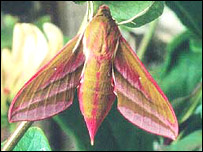
The elephant hawkmoth (Image: Roy Leverton,
Butterfly Conservation) |
We
walk with torches down a path through the woods. The moths are out
and I can feel them flitting around, brushing against my face.
As we reach the moth trap, bathed in bright white light, they are
suddenly everywhere; in my hair, crawling down my neck. The moths
skip and dance around us, attracted to the mercury vapour bulb.
Word has reached us that a rather special moth has been found.
But all I can see at the bottom of the Perspex box is a large, dull,
brown insect.
Mark Calway, who leads the Berkshire Moth Group, reaches in and
gently fishes it out.
"An elephant hawk-moth," he says, and the small group of adults
and children that have gathered around him move in closer.
He turns the moth over. It is nothing like the brownish creature
of first glance. Its beautiful deep pink wings, edged in iridescent
green, would put even the brightest of butterflies to shame.
'Beautiful creatures'
It's the evening of National Moth Night and Day, and I've joined
some of Britain's army of amateur naturalists who are taking part in
the country's largest survey of moth species.
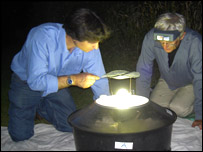
Grahame Hawker (left) and Norman Hall
|
The moth has
always played second fiddle to its close relation, the butterfly.
Now, though, the study of moths is growing in popularity in the UK,
with many enthusiasts setting up moth traps in their back gardens.
Among them is Grahame Hawker, one of the organisers of tonight's
moth hunt at the Maiden Erlegh Local Nature Reserve in Earley, near
Reading.
"To get a bunch of creatures together and name them - there is a
human instinct for that," he says.
"But you are dealing with beautiful creatures - they've got
beautiful intricate markings, fabulous colours and the closer you
look the more beautiful they are."
'Fantastic shapes'
Our walk takes us past several traps set up around the reserve's
meadows, woods and lake.
Fifty-three-year-old Nigel Parsons has come up from west London
for the occasion. Originally interested in butterflies, he has
recently become a moth convert.
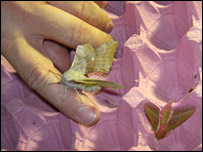
An elephant hawkmoth (right) is among the
catch |
"I think
it's the fact they're so mysterious; you hardly ever see them," he
says. "When you do they are fantastic shapes and colours."
We stroll through the wild flower meadow, where the air smells of
wet grass and smoke from a distant barbecue. When we reach the trap,
a man with a torch strapped to his head looms out of the shadows.
Norman Hall, who has been studying moths in England, France and
Spain for the past 30 years, takes egg boxes out of the bottom of
his trap and taps the moths clinging to them on to a sheet spread
over the grass. Then he lifts each moth gently on to his finger for
identification.
"This is the hearts and darts," he says, pointing to a moth with
a little heart and a little dart on each wing.
He writes each species down in a notebook, the Latin name next to
the common English name.
As he works, more people appear - parents with young children
excited at being up so late; a group of surly teenagers who have
been getting up to goodness knows what in the woods; members of the
Earley environmental group conducting a survey of local wildlife for
the parish council.
Their enthusiasm is infectious: I'm starting to see what all the
fuss is about.
Moth 'addiction'
Hawker takes me to meet Susan Nicholls, aged 51, from nearby
Caversham, who has set up a sugar trap on the edge of the lake. We
examine a sheet of wood smeared with an enticing treat for moths -
half a pint of beer, a kilo of molasses sugar, a tin of black
treacle, and rum, all boiled together.
 |
 It's an addiction; there is so much to learn
|
Nicholls
first started studying moths in January, inspired by a walk in the
Lost Gardens of Heligan in Cornwall where she saw a trap being
emptied.
"By the end of 20 minutes I was hooked," she says. "I could only
think this is what I want to do."
Nicholls now sets up moth traps in her garden and rears
caterpillars in her kitchen. She is particularly fascinated by
metamorphosis, the point at which an adult emerges from its
chrysalis.
"It's so magical I just want to keep on doing it," she says.
"It's an addiction; there is so much to learn."
Threatened habitat
Moth hunting had its heyday in the Victorian era, when collectors
went out to beat caterpillars down from the trees.
Since then, many British moths have become extinct, from the
gypsy moth, last seen in around 1907, to the Essex emerald, which
disappeared in 1991.
Hawker, aged 46, remembers seeing the huge hairy caterpillars of
the garden tiger moth on his journey home from school.
"Every kid knew them," he says. "They used to be called the
woolly bear. But they haven't been seen for a very long time around
here."
He blames the loss of the British countryside, and modern farming
methods that have turned ancient flower meadows into green deserts,
where moths and butterflies cannot breed.
"The countryside should be mauve, yellow, cerise," he says. "It
should be everything but green."








 E-mail this to a friend
  Printable version
.gif)

