
The locust: A pest all over the
world |
Scientists
have discovered how migrating locusts avoid the danger of flying
over the sea.
Experiments show the insect is capable of detecting the polarised
reflections of large bodies of water.
This means it can switch flight paths when it encounters water,
boosting its chances of survival.
The research could lead to novel deterrents for locusts, which
can devastate large areas of farmland.
Many animals have eyes that are sensitive to polarised light:
basically light reflected off a flat surface.
Light reflected from the sea is partly linearly polarised and
this may provide a flying insect with an indication of the nature of
the surface below them. Insects that live on or near water, for
example, are attracted to such surfaces.
Mirror study
Now, scientists in Israel and the US have confirmed that the eye
of the locust is sensitive to polarised light and that it uses this
ability to avoid crossing water.
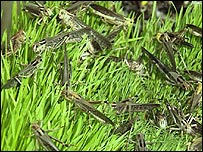
The locusts are attracted to new
growth |
They
found that tethered locusts avoided flying over a light-reflecting
mirror and, when given the choice, preferred to fly over a
non-polarised reflecting surface rather than reflected linearly
polarised light.
This may help migrating locusts avoid flying over water in
coastal areas, particularly at low altitude, according to Dr Nadav
Shashar, of the University of Maryland Baltimore County, and
colleagues.
"For a migrating desert insect, water presents a potential hazard
and large bodies of water, such as the sea, are especially
dangerous," they write in the journal Biology Letters, published by
the Royal Society.
"Therefore, detecting and avoiding such surfaces is beneficial to
them."
The idea for the study came from observations by volunteers of an
outbreak of locust migration near the Gulf of Aqaba last November.
Swarms crossed the length of the Sahara desert to reach Egypt via
the Sinai desert. But instead of crossing the 3-5km-wide Gulf, they
turned north and flew over land, turning back towards the shore if
they veered over water.









 E-mail this to a friend
  Printable version
.gif)

