Grasshopper Takes To The Trees On Prairie Research Site
Grass stretches as far as the eye can see across the
U.S. Great Plains, and more than 100 species of grasshoppers live in
the swaying fronds. But one plains-dwelling grasshopper species
prefers trees to grass, as a discovery at the National Science
Foundation's (NSF) Konza Prairie Long-Term Ecological Research
(LTER) site shows.
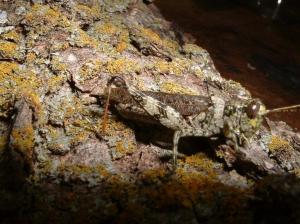
The grizzly spur-throat grasshopper is a large,
slow-moving insect that is nearly impossible to see against
lichen-covered tree bark. (Credit: Konza Prairie LTER
site)
Bison
Grazing Increases Biodiversity In
Grasslands (May 6, 1998) -- Grazing by herbivorous mammals like
bison increases biodiversity in North American
grasslands, says National Science Foundation (NSF)
ecologist Scott Collins, even during periods of frequent
burning ... > full story
A Kansas student from Fort Riley Middle School collected the
first specimen while participating in Konza's LTER schoolyard
project. According to Valerie Wright, Konza's education coordinator,
the specimen wasn't recognized at first to be a new species to
inhabit the Konza Prairie.
Konza scientist Ted Hopkins later identified the rare,
tree-dwelling creature as the grizzly spur-throat grasshopper.
"LTER schoolyard projects provide wonderful opportunities for
students of all ages to become involved in the excitement of
science," said Henry Gholz, LTER program director at NSF. "Often, in
cases such as this, students are responsible for collecting valuable
field data and increasing our knowledge of the natural world."
Melanoplus punctualatus, as the grasshopper is known to
scientists, was first identified in the United States in 1862. It's
usually found in eastern hardwood forests and in the pine forests of
the southeast. The species had been reported only twice in
Kansas.
"Its discovery on Konza is a big surprise," Hopkins said.
He discovered two of the unusual grasshoppers basking in the sun
on the wall of an old house located on the Konza site. Wright, who
is also an entomologist, later found five more on tree trunks near
the house.
The grasshopper is a large, slow-moving insect, Hopkins said,
"and given its protective coloration--medium-gray speckled with dark
dots, sometimes with yellowish and whitish areas--it disappears
against lichen-covered tree bark."
Hopkins thinks the Konza Prairie grasshoppers are found only
along wooded areas near creeks. He is continuing his research near
trees where the grasshoppers have been seen, watching for tiny
first-stage insects that hatch from eggs and trying to collect
enough adults to determine their feeding habits.
Editor's Note: The original news release can be found here.
This story has been adapted from a news release issued by
National Science Foundation.
Can't find it? Try searching ScienceDaily or the
entire web with:




.gif)
.gif)