|
Source: |
|
 |
|
Date: |
2005-03-23 | |
|
Bugs, Even The 'Bad' Ones, Can Be Educationally Beneficial, New
Book Says
CHAMPAIGN, Ill. — We have much to learn from bad
bugs, according to Gilbert Waldbauer, whose book “Insights From
Insects: What Bad Bugs Can Teach Us” was published today (Prometheus
Books).
“We know a lot about pests, because so much money is spent on
their research,” said Waldbauer, professor emeritus of entomology at
the University of Illinois at Urbana-Champaign. Of the 900,000 known
species of insects, a mere 2 percent are considered pests. Just as
some plants growing where they are not wanted are considered weeds,
insects are considered pests only when they adversely affect people,
Waldbauer writes.
For example, homeowners typically think of termites as pests, but
in forests termites are important for recycling dead wood.
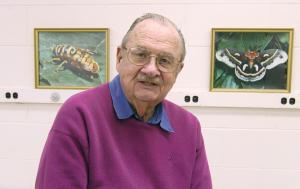
Waldbauer spent 15 years studying the cecropia moth (Hyalophora
cecropia), which he collected by driving along streets in Urbana,
Ill., and retrieving cocoons from trees. With its colorful 5- to
6-inch wingspan, the nocturnal cecropia moth is the largest North
American moth.
In “Insights From Insects,” Waldbauer describes 20 different
types of pests. He includes how each pest is destructive to humans,
how it sustains itself through feeding, reproduction and avoiding
predators, and the various methods that people use to get rid of
pests. The book is written for a general audience.
“Many basic biological concepts such as evolution and genetics
can be learned through pests,” Waldbauer said. For example, he
described recent evidence of how a new species of fruit fly is
evolving based on how its diet differentiates it from other fruit
flies.
Waldbauer uses examples from history, his career and
conversations with his entomologist colleagues to illustrate what we
can learn from bad bugs.
Many of the pests he describes are found in Illinois, including
the corn rootworm. Other regional insects also are mentioned, such
as the evergreen bagworm that spans the east coast of the United
States and stretches westward to Nebraska and Louisiana. Other pests
with wider ranges, such as disease-toting mosquitoes,
produce-feasting fruit flies and sap-sucking aphids, also are
featured.
The history of how many insects were spread to the United States
also is discussed. For example, in 1869, the gypsy moth (Lymantria
dispar) arrived in Medford, Mass., from Europe when the French
naturalist Leopold Trouvelot brought them to use in silk culture
experiments. A few escaped as caterpillars and their descendants
thrived, leading to rampant defoliation 20 years later.
Such destruction has led people to devise various methods to
exterminate bad bugs.
“The least creative way to get rid of bad bugs is by using
insecticides,” Waldbauer said. Biological control, a practice in
which natural predators are introduced, is a more creative and
effective way to control pests, he said. In the book, Waldbauer
explains many historic and recent examples of how people control
pests without insecticides.
For example, in 1886, the cottony cushion scale (Icerya
purchasi), accidentally imported from Australia, threatened
California’s early citrus industry. At times these pests, whose
sucking beaks are permanently attached to and suck juice out of
leaves, infested trees so densely that the trees appeared to be
covered with snow.
Introduction of 129 Australian ladybird beetles (Rodolia
cardinalis), a natural predator of the scale, to a Los Angeles
orange grove destroyed almost all of the pests within six months.
“By the end of 1889, the scale was no longer a threat anywhere in
California,” Waldbauer wrote.
Waldbauer also recounted a more recent study in which tsetse
flies were feasting on and causing infections in cows in Zimbabwe.
Entomologists led by Steve Torr of the University of Greenwich in
the United Kingdom placed 60,000 fake cows made of cloth and steeped
in insecticide on cattle ranches. Instances of infections dropped
from 10,000 to 50 per year. These findings were reported in the
journal Science in 2001.
Not only do insects interact with people, some insect species
share characteristics with humans, Waldbauer said. For example, the
tsetse fly has an analogue of a mammalian uterus. “Milk-secreting
glands that empty into the ‘uterus’ feed the developing larva.
Tsetse milk is white and chemically similar to human or cow’s milk,”
Waldbauer wrote in a chapter titled “Guaranteeing descendants: The
role of parental care.”
Waldbauer emphasizes that insects can be useful to humans. For
example, he said, maggot therapy has been used to remove gangrenous
tissue while leaving healthy tissue intact. Because of the
increasing prevalence of bacterial resistance, the therapy has been
used recently to replace antibiotics.
Since retiring in 1995, Waldbauer has written several books,
including “The Handy Bug Answer Book,” “What Good are Bugs” and
“Insects Through the Seasons.” He is now completing work on his next
book, “Aquatic Insects: Bugs In and Over the Water.”
Meredith Waterstraat illustrated “Insights From Insects.”
Waterstraat, a former Illinois graduate student in mathematics
education, also illustrated “What Good are Bugs.” Waldbauer and
Waterstraat began working together after he saw and was intrigued by
her paintings of beetles at the Anita Purves Nature Center in Busey
Woods in Urbana.
Editor's Note: The original news release can be found here.
This story has been adapted from a news release issued by
University Of Illinois At Urbana-Champaign.
|



.gif)
.gif)