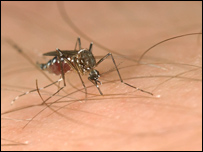
Mosquitoes spread diseases such as
malaria |
Some
insect repellents which use electronic buzzers to deter mosquitoes
are ineffective, a consumer group says.
Holiday Which? said the devices did not stop mosquito bites
during user tests and should be withdrawn from sale.
It has passed its findings to Trading Standards, warning people
who use the repellents may be given a false sense of security.
Manufacturers said while nothing gave 100% protection, their
products were effective and based on sound science.
The electronic buzzers emit high or low frequency sounds -
designed to replicate the wing beats of either a male mosquito, or a
dragonfly, which feeds on the insects.
 |
 Over the years, we have received glowing testimonials as to
the effectiveness of this product
Over the years, we have received glowing testimonials as to
the effectiveness of this product 
|
The theory is that this should frighten female mosquitoes - which
can carry diseases such as malaria - away.
Holiday Which? expressed particular concern about a device
marketed by the company Prince Lionheart, which performed badly in
tests against two species of mosquito.
The device is designed to clip on to babies' cots to protect
infants from attack by mosquitoes.
In total 18 products were tested - each six times - by a team at
the London School of Hygiene and Tropical Medicine, with 30
mosquitoes used in every trial.
Buzzers all poor
All four buzzer devices tested produced disappointing results -
but other products did much better.
Holiday Which? editor Lorna Cowan said: "Some repellents offered
complete protection and zapped mozzies in next to no time.
"People are at their most vulnerable when they're asleep so
plug-ins are a worthwhile investment, though in malarial areas
people should also use impregnated bed nets.
"We think others, such as the buzzers we tried, were a shocking
waste of money, didn't offer any protection at all and offer nothing
but a false sense of security. They should be removed from sale."
Repellents containing plant oils were less effective than their
synthetic counterparts, the researchers found.
Four types of plug-in device which emitted mosquito repellent
vapours were 100% effective when tested.
Not realistic
Holiday Which? said the best repellents for use outdoors contain
at least 30% diethyl tolumide, known as Deet.
Masta and Lifesystems wrist and ankle bands soaked in a Deet
solution gave excellent although not total protection.
Anthony McCarron, of Prince Lionheart UK Ltd, said the "avoidance
technology" used in their Electronic Mosquito Repeller was solid and
had been proven in field tests.
But he said no mosquito repellent was 100% effective against all
types of mosquito in all situations.
He also added that the Holiday Which? tests were not necessarily
realistic, as the mosquitoes had been starved for several days
before use.
"In environments were the mosquito is not confined or starved,
such as the Which test, a mosquito is more likely to avoid predators
such as the dragonfly and because of this we have found the
avoidance technology to be successful."







 E-mail this to a friend
  Printable version
