At
first glance, it looks so inviting, so smooth and soft, so harmless,
like a baby kitten. Your first inclination is to pick up this fuzzy
little hairball and hold it in your hands. Those of you who have been
taken in by the puss moth caterpillar's docile appearance learned a
swift and lasting lesson in the art of deception.
|
JIM HOWELL / Special |
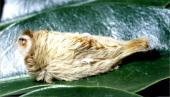
The
sting of the puss moth caterpillar can pack a painful wollop —
including vomiting and headaches — for those unwise enough to touch the
larva.
|
|
|
|
|  |
DESCRIPTION
The adult puss moth is a brownish-orange moth with blunt wings and a
wingspan of about 1 to 1 1/2 inches. The body is covered with long,
wavy hair. Though the adult also has nettling hairs, it rarely comes in
contact with humans. The larva, however, is an entirely different
matter. It is about 1 inch long, with a dense, soft brown coat marked
with speckles of white hair that conceal a number of shorter
urticating, or poisonous, spines beneath. At the rear, the hairs come
together to form a tuft.
IMPACT
Though this species rarely causes any economic damage to host
plants, it can be a serious health hazard to those with whom it comes
into contact. Stings from the nettling hairs beneath its outer coat may
cause intense pain, which usually develops immediately or within a few
minutes of contact.
Additional symptoms include nausea, vomiting and headache. An ice
pack should be applied to the sting, and antihistamines may be helpful
in reducing the itching and burning. If serious allergic reactions
occur, seek medical attention immediately. For a more detailed list of
symptoms, visit www.emedicine.com/emerg/topic794.htm
BIOLOGY
Adults emerge in late spring or early summer and deposit up to
several hundred eggs on selected hosts, including but not limited to
elm, hackberry, oak and pecan. Though there may be up to two
generations a year, the larvae are far more common in the fall. As cool
weather approaches, larvae spin a distinctive cocoon on the branches of
their host plant. The top of this cocoon has a scarlike structure
through which the adult moth emerges the following spring.
CONTROL
Contact your local county Extension agent for insecticide
recommendations labeled for these caterpillars on your ornamental
plants.
Jim Howell is a University of Georgia entomologist and an
associate of the Georgia Museum of Natural History. His column appears
biweekly. E-mail him: hey_bug_doctor@hotmail.com or write him in care
of AJC Home & Garden, P.O. Box 4689, Atlanta, GA 30302.











 subscription. Only $10 per month. Subscribe now!
 EMAIL
THIS
EMAIL
THIS PRINT
THIS
PRINT
THIS MOST
POPULAR
MOST
POPULAR

 MOST POPULAR STORIES
 EMAIL THIS
 PRINT THIS
 MOST POPULAR
