WASHINGTON, February 14 -- More than 100 tiny moths
from Australia were released in Florida this morning to begin a
biological control effort against an invasive weed that has spread
over more than 100,000 acres in the state.
Scientists with the Agricultural Research Service (ARS) and
officials from the State of Florida released the moths this morning
at the Jonathan Dickinson State Park in Hobe Sound, Fla. The moth,
Austromusotima camptonozale, is the first biological control agent
approved for release against the invasive weed Old World climbing
fern, Lygodium microphyllum.
This aggressive vine has spread across south and central Florida,
scaling the stems or trunks of other plants to form thick vegetative
blankets. On the ground, it creates tough, spongy mats that smother
grasses, low-growing shrubs and small trees.
"Land managers consider this fern to be the state's worst
invasive species, so we hope the moth will begin to offer
much-needed relief," said ARS entomologist Robert W. Pemberton, at
the Invasive Plant Research Laboratory at Fort Lauderdale, Fla. He
leads the international research effort to develop biological
controls for the weed.
Climbing fern is native to the Old World tropics including
Australia, Africa, tropical Asia and the Pacific Islands but doesn't
cause problems in those areas, probably because natural enemies help
keep it in check. Searching for natural enemies of the fern in its
native habitat, scientists at the ARS Australian Biological Control
Laboratory in Indooroopilly identified several promising candidates,
including A. camptonozale. Then they tested these biocontrol
candidates to make sure they would only feed on the fern and not on
other, nontarget plants.
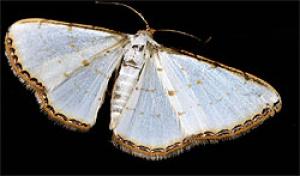
The moth released today measures just half an inch from wingtip
to wingtip and is bright-white, with spots and stripes on its wings.
The larvae of the moth feed on climbing fern's leaves, damaging the
vines.
The Indooroopilly scientists shipped a supply of moths to the
Florida Department of Agriculture and Consumer Service's biological
control quarantine facility in Gainesville for three years of
testing by scientists with the ARS Invasive Plant Research
Laboratory and the University of Florida. Upon completion of those
tests, federal and state approval was obtained to turn the moths
loose at climbing-fern-infested sites in Florida. This biological
control program is a collaborative effort among ARS, UF, SFWMD, and
Florida Department of Environmental Protection.
Herbicides have been the major weapon against climbing fern, but
the weed thrives in remote wetland areas that are difficult and
expensive to treat. A. camptonozale and other biocontrol organisms
may provide an effective and more environmentally friendly
alternative to the use of herbicides in wetlands.
ARS is the U. S. Department of Agriculture's chief in-house
scientific research agency.
Editor's Note: The original news release can be found here.




.gif)
.gif)