 |
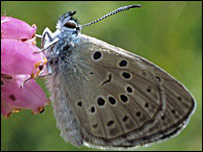
The alcon blue lives on boggy
heathland 
|
Advanced
camera and sound techniques are giving scientists remarkable new
insights into insect behaviour.
Caterpillars of large blue butterflies have been shown to
communicate with ants, making noises that fool them into caring for
the larvae as if their own.
And scientists are now looking into the idea that these sounds
are actually overheard by the wasps that seek out such caterpillars
to lay eggs in them.
It is one of many amazing tales to be found in TV's Life in the
Undergrowth.
The new BBC natural history series from Sir David Attenborough
starts on Wednesday.
|
 We can get up close and tight, and then you see
mind-blowing things
We can get up close and tight, and then you see
mind-blowing things 
Sir David Attenborough, TV naturalist
|
It
shows invertebrate activity never before caught on television
cameras.
"In the past, in order to get close to something, you had to pour
light on it; so much so you were at risk of frying the thing - and
you certainly inhibited natural behaviour," Sir David said.
"We've now got such sensitive electronic cameras that we don't
need that amount of light, and we've also got tiny, tiny lenses; so
we can get up close and tight, and then you see mind-blowing
things."
Seek and destroy
The alcon blue butterfly (Maculinea alcon) of central
Europe has long been recognised as a great con artist.
Its caterpillar emits sounds and a chemical signal which
essentially "instructs" worker ants to pick it up and carry it back
to their nest, where it is fed, cleaned and cared for as if it were
one of the queen ant's own brood.
|
The TV series shines a light on the glories of
the undergrowth
|
The
caterpillar can live for up to two years inside the nest before
pupating into a chrysalis, from which a new butterfly emerges.
It has an enemy, however: a parasitic wasp (Ichneumon
eumerus). Unlike the ants, the wasp seems to know an impostor is
present and, in what appears like a kamikaze manoeuvre, will enter
the nest to find the caterpillar.
Jeremy Thomas, from the Centre for Ecology and Hydrology (CEH) in
Dorset, UK, has been studying large blue butterflies for over 30
years and recently discovered how this wasp avoids death by
releasing a chemical signal, or pheromone, of its own.
This
not only repels the ants but causes them to attack one another. In
the midst of this confusion the wasp seeks out the caterpillar and
injects an egg deep inside its body.
When the wasp leaves the nest everything returns to normal and
the caterpillar is once again fed and cleaned by the ants. But, when
it turns into a chrysalis, it is eaten from the inside by the
injected wasp grub - and it is the wasp that emerges to fly from the
nest, not another alcon blue butterfly.
The right tune
Photographing all of this for TV is a first; but the great
breakthrough for the scientists has been in getting clear recordings
of the noises made by the blue caterpillars.
What is more, the CEH team has been able to show just what a
direct effect these sounds have on the ants.
"We can get clean sounds and, using miniature equipment, we can
get the caterpillars and ants behaving much more naturally than in
the past," Dr Thomas told the BBC News website.
|
The wasp is exceedingly rare and finding a grub
is essential
|
"Also, we
can now play the sounds back to the ants, and that shows the sounds
of the caterpillar match the ant it lives with much more closely
than anyone thought previously.
"The ants react to the sounds in a positive way. They go to the
microphones and tap them with their antennae."
But what of the wasp? The emerging hypothesis is that it hears
these sounds, too. And although the ants may be fooled into thinking
the caterpillar is one of their own, the wasp is not.
"The chemical signal used by the butterfly is so like the ants'
own chemicals that it fools them deep down in the nest. These are
not volatile chemicals either - they're ones you have to touch. So,
we reason the wasp doesn't 'sniff' out the caterpillar," Dr Thomas
explained.
"The sounds on the other hand are designed to travel over
distances, and we suspect that's what the wasp is using."



 E-mail this to a friend
  Printable version
 Enlarge Image
 See show
highlights
See show
highlights.jpeg)
.jpeg)
.gif)

