Scientific insights come at the darnedest
times.
Animal behaviorist Sean O'Donnell was having an afternoon cup of
coffee when a giant earthworm exploded out of the leaf litter
covering the jungle floor in an Ecuadorean nature preserve. The
worm, later measured at nearly 16 inches long, was pursued by a
column of hundreds of raiding army ants that quickly paralyzed or
killed it.
That sighting, and another involving what turned out to be the
same species of army ant feeding on the carcass of a snake, has led
O'Donnell of the University of Washington and several colleagues to
offer a new theory on the origin of cooperative hunting behavior in
army ants, which are among the most socially complex animals
known.
Writing in the current issue of the journal Biotropica, O'Donnell
and biologists Michael Kaspari of the University of Oklahoma and
John Lattke of Universidad Central de Venezuela, propose that mass
cooperative food foraging, a key element in the behavior of army
ants, may have begun as a way to subdue large prey.
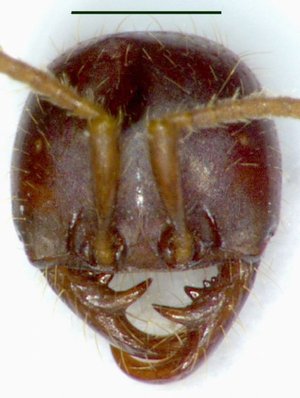
The species that O'Donnell observed is called Cheliomyrmex
andicola and it lives mainly underground in New World tropical
rainforests. It had been previously identified, but little was known
about its behavior or prey until the two chance encounters at the
Tiputini Biodiversity Station, an ecological preserve in eastern
Ecuador.
The ants are brick red in color and their size would be
considered medium or large when compared to most common ant species
found in United States. What makes Cheliomyrmex such a fearsome
predator is that its workers have claw-shaped jaws that are armed
with long, spine-like teeth. These teeth may serve to help
Cheliomyrmex workers attach themselves to their prey's skin during
attack O'Donnell, who was bitten and stung when he collected
Cheliomyrmex specimens, said the ants' stings were particularly
painful and itchy, comparable to the stings of fire ants. He and his
colleagues believe the venom in a Cheliomyrmex sting is toxic and/or
paralytic, considering how quickly the giant earthworm became
immobile after being attacked.
The researchers said the species is apparently unique among New
World army ants in removing and consuming vertebrate flesh, based on
the observation of the ants feeding on the dead snake. They noted
that raiding parties of other New World army ants occasionally sting
and kill small vertebrates such as lizards, snakes and birds, but do
usually not consume them. Other New World army ants prey heavily on
insects and other invertebrates.
O'Donnell said Cheliomyrmex is related to Old World driver ants
in Africa, which also have large-toothed jaws and feed on
large-bodied prey. The ancestor of Cheliomyrmex may have split from
Old World army ants as long as 105 million years ago, at around the
time when Africa and South America separated during the breakup of
the giant continent Gondwana.
"Cheliomyrmex may be telling us that cooperative hunting of large
prey is an evolutionary predecessor of going after smaller prey,"
said O'Donnell. "Typically, army ants follow a lifestyle of
attacking other social insect colonies. But Cheliomyrmex is not
following this lifestyle."
The discovery of Cheliomyrmex 's predation was part of a larger
project to sample the number of army ant species and their activity
at four New World tropical rainforest sites in Costa Rica, Panama,
Venezuela and Ecuador. The research was funded by the National
Geographic Society.
Editor's Note: The original news release can be found here.