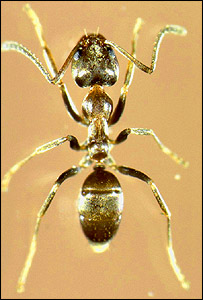
Natural aggression kept numbers under control
in the ants' native country |
A
giant colony of ants stretching 100km (62 miles) has been discovered
in the Australian city of Melbourne, threatening local insect
species.
The ants, which were imported from Argentina, are ranked among
the world's 100 worst animal invaders.
Although they exist in their usual smaller group size in their
homeland, the colonies have merged in Australia to create one
massive super colony.
Experts fear that the invasion poses a threat to biodiversity in
the area.
Introduced pest
Elissa Suhr, from Monash University, Melbourne, said the
introduced pest's natural aggression kept numbers under control in
its native country.
But the lack of genetic diversity in the ants found in Australia
has allowed them to build a super colony.
"In Argentina, their native homeland, ant colonies span tens of
metres, are genetically diverse and highly aggressive towards one
another," Dr Suhr said.
"So population numbers never explode and they are no threat to
other plants and animals.
"When they arrived in Australia, in 1939, a change in their
structure occurred, changing their behaviour so that they are not
aggressive towards one another. This has resulted in the colonies
becoming one super colony."
Dr Suhr said the Argentine ants have killed native ants, and
consumed many other insects, posing a major threat to biodiversity.
Taking over
She said Argentine ants could even displace native species by
taking over local habitats and preying on insects commonly eaten by
Australian ants.
Australia is not the only country to be invaded by Argentine
ants, according to Dr Suhr.
"In California, they have displaced native ants, decreased the
diversity of other native insects, affected the dispersal of seeds
and even decreased lizard numbers," she said.
Australian scientists are studying colonies in Perth and Adelaide
to see if they share the same genetic structure and behaviour as the
Melbourne ants.
If they do, a super colony several thousand miles wide could
spread across southern Australia.
Your comments
I live in Melbourne, and was unaware that our local ant problem
had reached such behemoth proportions. For several months now, ants
have had the run of our property, invading everything from the
downstairs kitchen to the upstairs bathrooms. Thick black trails of
insects are now a common site in every room of our abode, something
that had never happened until the beginning of this year. I thought
this problem was localised and was shocked to find out that the
colony spread out over 100kms.
Anthony Hill, Melbourne,
Australia
We have them in the wine area of Barossa Valley and once in the
house they are worse than white ants. Ant trap poisons have limited
effect.
Graham York, Nuriootpa, South Australia,
Australia
We live in a house very close to the city centre in Melbourne,
and we have certainly noticed an increase in the number of ants
during the last year! They appear in odd places, even where there
doesn't appear to be anything for them to eat there. If some food
does get left out accidentally, then within a short period there
will be a swarm of ants.
Douglas, Melbourne,
Australia
I'm not from Melbourne but Perth, Western Australia and I live in
a residential block of 8 units and I've noticed them on our property
for the past 12 months. Their nests are everywhere. You can always
tell an Argentine ant by their small size and the fact that when you
crush them they do not leave behind that characteristic "ant" smell.
They are incredibly invasive as you will find them in their hundreds
on your kitchen side. I have also noticed that the other native ant
colonies that were around are no longer so.
Gavin, Perth,
W.A.







 E-mail this to a friend
  Printable version

