A maggot
became a key witness in a murder inquiry in Perth, Australia, in the
latest breakthrough for forensic entomology - the science of using
insects to crack criminal cases.

Perth is the home to much of the entomological
research |
Ian
Dadour, professor of entomology at the University of Western
Australia, was able to prove that, although the corpse was
discovered in the Australian outback, the murder had taken place in
much different surroundings.
His evidence came from the type of maggot found in the tissue of
the corpse.
"We had a body that was obviously held over by whoever murdered
them originally in the city, and then they dumped them in the bush,"
Professor Dadour told BBC World Service's Discovery programme.
"When the body was found, we found insect material that only
occurs in the city.
"This is a very strong indicator that the body was murdered in
the city, where this fly occurs.
"This information is vital, because it sets up two crime scenes -
the scene where the body is found, but also there's another one out
there that needs to be investigated."
Time of death
Forensic entomology has not long come into use in police
investigations, as its potential for yielding clues to what may have
occurred at the scene of a crime is still being fully discovered.
Forensic entomology has only recently come into
practice |
In
Britain, it was pioneered by the late Dr Zakaria Erzinclioglu, whose
research helped prove that the development of insects inside a
corpse could point to the time of death.
"The scenario in the first case was fairly straightforward - it
concerned a body with maggots in it," Dr Erzinclioglu told the BBC
in an interview before his death.
"Flies will come to a body - usually in the summer or spring or
autumn - fairly soon after death.
"When that happens, they will lay their eggs, they will hatch,
the maggots will develop - and if one can arrive at an estimate of
the age of the maggots, one has a minimum time since death.
"On the basis of finding that the maggots are five days old, I
can say that the death did not occur later than five days ago."
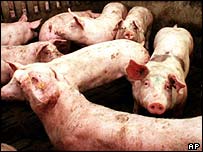
Pig carcasses are the closest match to human
corpses |
Dr
Erzinclioglu also argued that the species of fly could be used to
pinpoint the time of death - an area of research now being
investigated at the Natural History Museum (NHM) in London.
"Blowflies are the species that are most commonly found on
murdered bodies, and they come to the body most rapidly after the
body dies," explained the NHM's Dr Martin Hall.
Incubators at the museum, set to different temperatures, are
being used to study the development rates of flies.
This can then be used to predict how old the maggots are on a
body, to give a more precise time of death.
Pig carcasses
However, outside of the lab, a much bigger series of experiments
is being tried in the bush 15 kilometres outside Perth by Professor
Dadour's team from the University of Western Australia.
This involves the use of dead pigs - some dressed in human
clothes - to mimic human corpses, after tests performed by the FBI
proved that pigs "best simulated" human decomposition.
 |
 Some like you when you're fresh dead,
some like you when you're in the bloat phase, and some like
you when you're chewy Some like you when you're fresh dead,
some like you when you're in the bloat phase, and some like
you when you're chewy 
|
The pig
carcasses are left under cages and studied every day for the type of
insects that are inhabiting them.
The team has subsequently been able to identify which insects
correspond to the phases of corpse decay.
"If you're dead for longer than two or three minutes, you've got
flies starting to visit you - at least, visit you in the sense that
they are attracted to you as a mammal lying on the ground, and
certain odours you exude," the professor said.
"They'll fly across you, they'll land on you - but they won't do
any egg-laying or live larvae laying or anything like that.
"After about four hours, you've got some sort of fly material on
you."
In the early stages after death, flies begin laying eggs in
orifices or open wounds, he added.

Other insects can be helpful in pinpointing the
time of
death |
"The body
then changes as it decomposes, so you get this successional change
in the body - it goes through fresh dead, then through putrefaction
and fermentation, bloat, active decay, dry decay, skeletal."
And as the body goes through these changes, different insects
come in. Knowledge of this could be essential for establishing the
age of the corpse.
"Some [insects] like you when you're fresh dead, some like you
when you're in the bloat phase, and some like you when you're
chewy," Professor Dadour added.
And recently, it has been discovered that the maggot can also
supply other vital clues - including the cause of death.
Cause of death
Crime novelist and forensic scientist Kathy Reichs told Discovery
that she had found out how this could be done when researching her
book Death Du Jour.
"In Death Du Jour, I used forensic entomology because I teach it
on and off at the FBI academy," she said.
"We teach special agents how to recover human remains at a site,
and one of the people that comes in for that is a forensic
entomologist from Hawaii.
"You are what you eat - so if maggots have been feeding on the
body of someone who was a chronic drug user, for example, you're
probably going to pick that up in the gut of the maggot."
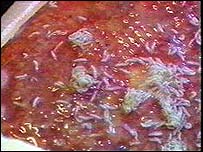
Maggots can contain a great deal of information
about the corpse |
Especially
in older corpses, that sort of information could prove essential -
for example, in proving that the deceased had died from a drug
overdose.
Professor Dadour added that maggots were "little chronicles of
information," and that drug use was not the only cause of death they
could identify.
"You can identify drugs in maggots - an extension of that, which
is what we've been doing here, is the identification of gunshot
residues in maggots," he said.
He pointed out that if a body had been shot but the bullet had
left no marks on the bone, it would still be possible to trace the
cause of death from maggot casings long after the body had been
reduced to a skeleton.
"You can actually extract gunshot residue from spent pupal cases,
and they hang around crime scenes for up to two years," he said.
"So the work we've done here actually can demonstrate that you
could infer a body had been shot, even after two years."








 E-mail this to a friend
  Printable version



.gif)

