





Ants Use Acid to Make "Gardens" in Amazon, Study Says
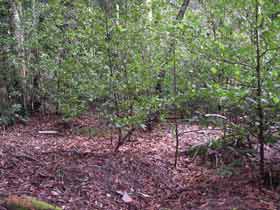
Ants in the Amazon rain forest labor to keep their territory free of all plants except for one tree species, according to a new study. Scientists call these cultivated spaces devil's gardens, after the local legends that hold they're home to evil spirits. Some of the gardens are at least 800 years old.
The ants' gardening tool of choice is a built-in herbicide: formic acid. Formic acid is a simple organic acid, used by humans to preserve foods and by nettles and red ants as a stinging agent.
"To my knowledge, no [other] insects—ants or otherwise—use formic acid as a herbicide," Megan Elizabeth Frederickson, a graduate student in biology at Stanford University in Palo Alto, California, wrote in an e-mail.
Frederickson, who is currently conducting ant research in the Peruvian Amazon, is the lead author of the study, which appears in tomorrow's issue of the journal Nature.
Paul Fine, an evolutionary biologist at the University of Michigan in Ann Arbor, also studies insect and plant interactions in the Amazon. He deemed the finding "very cool."
"I've never heard of that before," he said. Fine, who was not involved with the research, added that future studies should look into whether ants behave similarly in other parts of the world.
Devil's Gardens
According to Frederickson, devil's gardens consist almost exclusively of lemon ant trees. Local legend in the Peruvian Amazon holds that the gardens are cultivated by an evil spirit called the Chuyachaqui.
The Chuyachaqui is a mythical dwarf with one human foot and one hoof. He is able to transform himself to anyone's likeness. He often appears as a friend or family member to lone travelers in the jungle and leads them around in circles until they are lost.
"The devil's gardens are considered his home, and people avoid devil's gardens in fear of him, or at least traverse devil's gardens very cautiously," Frederickson said.
Previous research has suggested that the gardens are created as a result of allelopathy, a process by which one plant prevents another nearby plant from taking root through the secretion of chemicals.
Frederickson, however, noticed that the gardens only exist in the presence of the lemon ant (Myrmelachista schumanni). Lemon ant trees occupied by other ant species, or by no ants, always had other plants growing nearby.
MOST POPULAR STORIES
 |
Photo in the News: Oldest Known Maya Mural Reveals Royal TaleArchaeologists have revealed the final wall of the earliest known Maya mural, sa... |
 |
Oldest Known Maya Mural, Tomb Reveal Story of Ancient KingArchaeologists have revealed the final wall of the earliest known Maya mural, sa... |
 |
King Kong Island Home Is Pure Fantasy, Ecology Experts SaySkull Island, the mythical home of the great ape King Kong, is supposed to lie i... |
 | ||||||||||
|
|
| ||||||||
| ||||||||||






.gif)
