





Ants Use Acid to Make "Gardens" in Amazon, Study Says
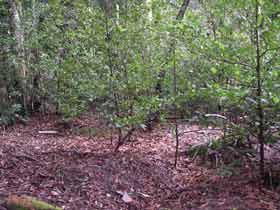
In addition, two previous studies had shown that lemon ants cultivate small stands of other tree species. These observations led Frederickson to test whether the lemon ants are the cultivators of the devil's gardens.
To do so, she set up experimental plots in which saplings of a common Amazon cedar tree were planted inside and outside devil's gardens. Groups of the trees were then either exposed to or protected from the ants.
The ants attacked the exposed cedar trees, but the protected trees went unscathed. The ants attack by injecting formic acid into the tree leaves, which causes them to turn brown and fall off within five days.
Fine, the University of Michigan biologist, said Frederickson and her colleagues successfully show that the lemon ants play a major role in cultivating the devil's gardens. But, he noted, allelopathy should not be ruled out.
Plant chemicals may take weeks or months to kill off a neighboring plant, Fine said, much longer than the current experiment lasted. "It could be that both are happening," he said.
A longer-term experiment is required to completely rule out allelopathy, he added.
Cultivating the Garden
The cultivation of devil's gardens apparently begins when a queen lemon ant colonizes a lemon ant tree. As time passes more trees grow in the areas cleared by the ants, and the ant colony expands to occupy them.
"The largest colony in my study plot, which I estimate to be 807 years old, covers around 1,300 square meters [14,000 square feet]. This colony contains about three million workers and 15,000 queens," Frederickson said.
The ants are believed to prefer the lemon ant trees because they have hollow stems that serve as nest sites. Frederickson thought perhaps the ants decide to attack a plant based on whether it provides nest space.
In a follow-up experiment, however, she found that the ants attacked the Amazon cedar trees regardless of whether they contained nest space.
"I now think it is likely that the ants use chemical cues to distinguish between host and other plant species," she said.
Fine noted that while devil's gardens are mostly limited to the lemon ant tree, other plants are commonly found in the gardens, such as Melastomataceae shrubs and tree ferns. Perhaps, he said, those plants have a defense against formic acid or are in some other way fooling the ants.
Frederickson's research is part of a long-term goal to understand the role of ants in Amazon rain forest ecology.
The combined weight of all the ants in the Amazon is estimated to be four times greater than that of all of the region's mammals, birds, reptiles, and amphibians combined.
"In many ways, ants are the dominant animals in the Amazon," she said.
Free E-Mail News Updates
Sign
up for our Inside National Geographic newsletter. Every two
weeks we'll send you our top stories and pictures (see
sample).
MOST POPULAR STORIES
 |
Photo in the News: Oldest Known Maya Mural Reveals Royal TaleArchaeologists have revealed the final wall of the earliest known Maya mural, sa... |
 |
Oldest Known Maya Mural, Tomb Reveal Story of Ancient KingArchaeologists have revealed the final wall of the earliest known Maya mural, sa... |
 |
King Kong Island Home Is Pure Fantasy, Ecology Experts SaySkull Island, the mythical home of the great ape King Kong, is supposed to lie i... |
 | ||||||||||
|
|
| ||||||||
| ||||||||||







.gif)
